
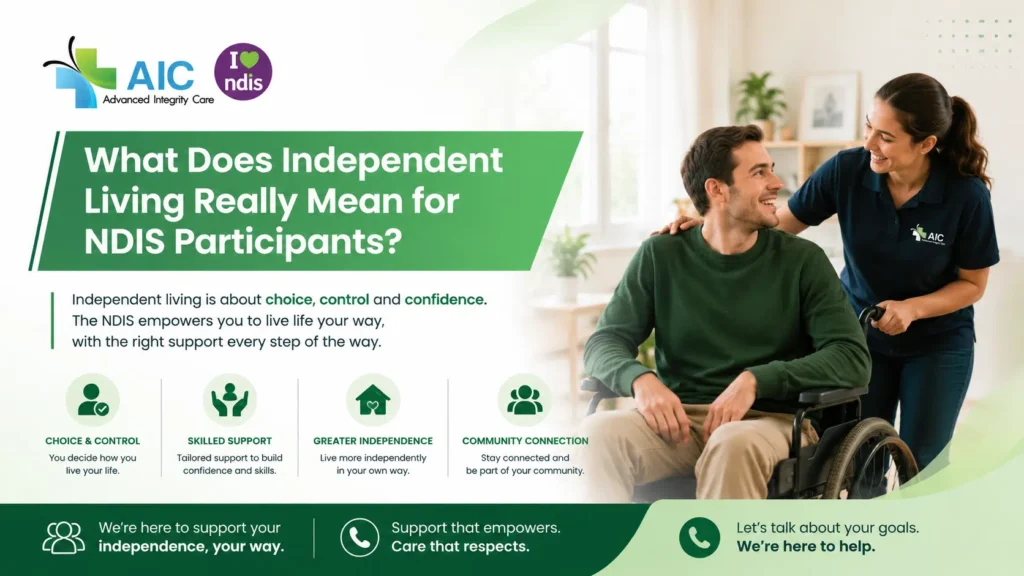
The independent living for NDIS participants can make the incorrect visual picture. For some, it means — living alone, doing all household chores without assistance and managing life by themselves. Nevertheless, real independence takes a different form for everyone.
Something that independence may mean for one of your participants is moving into a flat share and living freely within it. For one it might be learning how to make lunch; for another, getting on a bus with less support or choosing who can walk through their door as a support worker. As such, independence is not defined by how little assistance a person looks to receive. It should be gauged by the extent to which they have choice, control and confidence in their day-to-day life.
There are some home and living supports available from NDIS, particularly Supported Independent Living (SIL) and Individualised Living Options (ILO). These supports are intended to help eligible participants live according to their goals, needs and circumstances.
Just because you are living independently does not mean doing everything by yourself. Indeed, most people rely on others to some degree—whether it is for assistance with transport, domestic repairs, financial advice or emotional support.
With an NDIS participant, independent living can come in the form of helping them but also letting them be in charge. For example, a support worker might assist someone in preparing their dinner. But on the other hand, you have the participant choosing what to eat, purchasing vegetables or specials and then making a decision whether to sit down for a meal.
A person could need assistance in showering or dressing, but still be able to choose what clothes they wear and when, as well as have input about their routine, privacy and preferred method of help.
Real independence means having a voice. It also means being listened to when something does not feel right. Get details on SIL House Accommodation Vacancy in Lochinvar.
Independent living will not follow one fixed model. Instead, it may include:
Consequently, two participants with similar disabilities may choose completely different living arrangements. Both can still experience meaningful independence.
People often use independent living, SIL and ILO as though they mean the same thing. However, each term has a different purpose.
| Term | What it generally means | Who it may suit |
| Independent living | A broad goal involving choice, control, skill development and participation | Any participant working towards greater autonomy |
| Supported Independent Living (SIL) | Paid personal support for participants who need significant help with daily tasks at home, potentially across the day and night | People with higher support needs |
| Individualised Living Options (ILO) | A flexible support arrangement designed around where, how and with whom a participant wants to live | Participants seeking a personalised living arrangement |
| Specialist Disability Accommodation (SDA) | Purpose-designed housing for eligible people with extreme functional impairment or very high support needs | Participants who meet specific SDA requirements |
| In-home daily support | Assistance with personal care, meals, household tasks or routines in the participant’s current home | People who need scheduled rather than constant assistance |
SIL funding supports help or supervision with day-to-day activities within the home. It is generally intended for participants with higher support needs who require assistance throughout the day, including overnight support where necessary.
By comparison, ILO funding can help a participant explore where they live, who they live with and how their support arrangement works. It may combine paid assistance with help from family, friends, a host or community connections. Looking for a SIL House Accommodation Vacancy in Rutherford?
Autonomous living is often a process of baby steps taken again and again. Sure acquirin a new house can signal a major life step, but more often than not, each day of solid skill expansion is ultimately going to leave the most lasting mark.
The areas might include brushing her teeth or choosing appropriate clothing or handling their hygiene items or morning routines. In the beginning, a worker may deliver practical support. But, as confidence increases, that help could change to reminders or oversight.
Cooking involves more than using a stove. It may include selecting meals, writing a shopping list, understanding food safety and cleaning afterwards. Therefore, the support should match the participant’s current ability instead of taking over the entire task.
Tasks such as washing clothes, changing bed linen, sorting rubbish and keeping shared spaces tidy can build practical confidence. Moreover, learning these skills helps a person contribute to their household and feel a stronger sense of ownership.
Some participants may want help reading bills, creating a basic budget or remembering appointments. Support workers should explain each step clearly, rather than simply doing everything behind the scenes.
Independence also exists away from home. Public transport, libraries, social groups or medical appointments all provide meaningful activities to help with confidence and overcoming isolation.
Research commissioned through the NDIS has found that successful transitions to living more independently require a combination of person-centred planning, skill-building, appropriate supports, assistive technology and connection in the community. Get details on Nursing Services in NSW.
Good disability support creates opportunity. Poorly delivered support can create unnecessary dependence.
For instance, preparing every meal may be quicker for a support worker. Nevertheless, it may remove the participant’s chance to practise chopping vegetables, measuring ingredients or making decisions. A better approach could involve breaking the activity into manageable steps.
The participant might choose the recipe, while the worker assists with hot equipment. Next time, the participant may complete another part of the task independently.
This approach takes patience. Still, it respects the participant’s goals and helps develop real ability over time.
A participant’s home should feel like their own home, not a workplace controlled by service routines. Therefore, participants should have a genuine say in matters such as:
Safety remains important. However, safety should not automatically remove dignity, privacy or reasonable decision-making.
Adults with disability have the right to make everyday choices, including choices that others may not personally prefer. Support providers should discuss risks honestly and develop practical safeguards without controlling the person’s life.
Related Services:
» SIL House Vacancies In Newcastle
Broad goals such as “I want to be more independent” can be difficult to measure. Therefore, participants may benefit from turning the larger goal into smaller outcomes.
For example:
Broad goal: I want to manage more tasks at home.
Practical steps:
These steps make progress easier to recognise. Additionally, they give the participant, family and support team a shared direction.
Related Articles:
» Independent Living Support in NSW: How It Builds Daily Confidence
» Signs You May Benefit from Independent Living Support
» A Simple Guide to Independent Living Assistance in NSW
» How to Choose the Right Independent Living Support in NSW
» How Independent Living Support Can Build Daily Confidence
At Advanced Integrity Care – NSW, independent living support should begin with the participant’s own goals, preferences and daily circumstances. Support may include assistance with personal care, meal preparation, household routines, community access and capacity building, depending on the participant’s NDIS plan.
A respectful support worker does not assume control. Instead, they encourage involvement, explain options and adapt their assistance as the participant’s confidence changes.
Moreover, they provide continuous support to determine what works well. Some are more visual instructions, while some learn through demonstration, written memory or repetition. There is never one correct way, and that is more than alright. Looking for a NDIS Provider in Cameron Park?
Independent living is not the same as solo living or rejection of assistance. Instead, it refers to having control over the day-to-day aspects of life with an appropriate amount of support.
The best opportunities for gaining independence are fee-for-service funding whereby each opportunity is negotiated, practical skills development (even target numbers), accessible housing with support in the community but not living together, stable reliable workers assigned to an NDIS participant, assistive technology and well connected local communities. Ultimately, every decision has to be participant-centric.
Support opens doors, not resorting to quietly sliding one brand of control onto another. Independent living is not just an NDIS buzzword when participants can choose, learn, contribute and pivot. And it becomes an ordinary, self-DIY life.
Advanced Integrity Care acknowledges the Awabakal and Worimi Peoples as the Traditional Custodians of the land on which we work. We pay our respects to Elders past and present and extend that respect to all Aboriginal and Torres Strait Islander peoples.
admin@advancedintegritycare.com.au
Call: (02) 49511530
2/5 Withers St, West Wallsend NSW 2286, Australia
