Having a number of medicines at home can get confusing quite quickly. An insulin injection comes at morning and noon when something such as a tablet would need to be taken before breakfast while another afterwards, then an inhaler, injection or liquid medicine matches up many unique timings. This can increase a missed dose, double dosing or correct storage when the prescription changes.
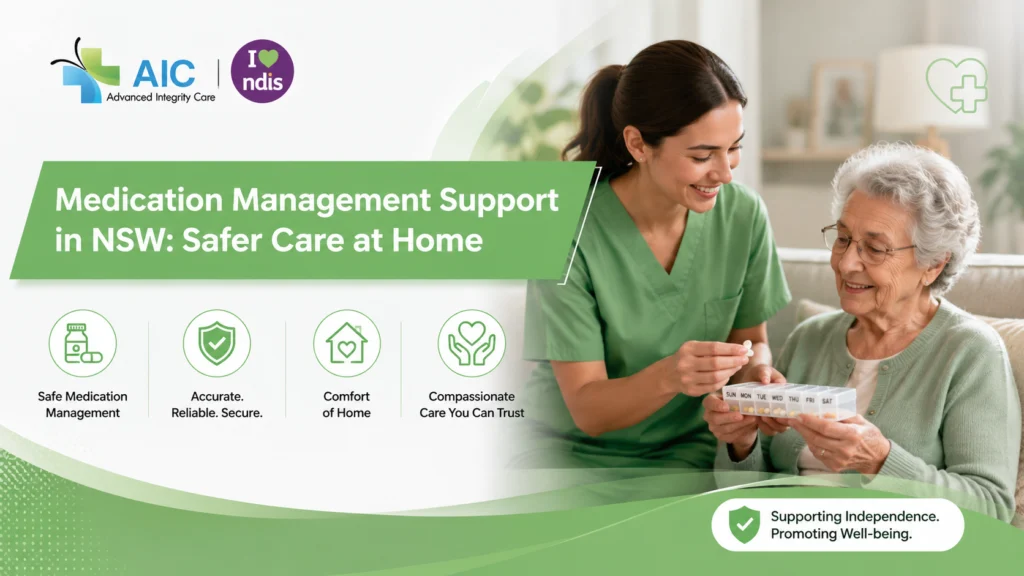
Medication management support in NSW can help provide a safer and less stressful Approach to daily life for older Australians, people living with disability and individuals post hospital discharge. A good support does not take away control from the person but rather helps the patient to learn their routine, remain independent and take medicines as per the professional’s directions.
At Advanced Integrity Care – NSW, medication support forms part of a broader approach to safe, respectful and person-centred care at home.
Medication management support refers to practical assistance that helps a person follow their prescribed medicine routine safely. Depending on the person’s care plan, abilities and clinical needs, support may include:
However, support workers do not independently prescribe medicines, change doses or provide clinical advice. Any change must come from an authorised healthcare professional.
The NDIS Practice Standards include specific requirements concerning medication management within the provision of supports environment. These standards focus on safe procedures, accurate records, appropriate worker training and participant involvement. Get details on NDIS SIL House Vacancies In Newcastle.
Drugs boost health, relieve signs or symptoms and assist independence but additionally have a tendency to do more damage than exact when someone takes incorrect treatment, poor dose or mixes merchandise without medical advice.
Safe medication practice encompasses proper prescribing, dispensing, administration and continuous monitoring according to the Australian Commission on Safety and Quality in Health Care. In exchange, they should also receive straightforward and easy to understand information about their medications and the associated risk factors.
At home, common difficulties may include similar-looking packaging, complex instructions, memory changes, reduced vision, swallowing difficulties or prescriptions from several doctors. In addition, a recent hospital admission may lead to changes that are not immediately clear to the person or family.
As a result, consistent in-home medication assistance can provide an extra layer of safety.
Medication risk | What may happen | Helpful support |
Missed dose | Symptoms may return or treatment may become less effective | Timely reminders and clear documentation |
Double dose | The person may become unwell or experience adverse effects | Medication records and pharmacy-packed systems |
Outdated medicine list | An old or ceased medicine may still be taken | Regular review with the GP or pharmacist |
Incorrect storage | Heat, moisture or unsafe access may affect safety | Storage checks based on pharmacy instructions |
Several prescribers | Medicines may interact or instructions may conflict | One current medicine list shared with the care team |
Hospital discharge changes | New, stopped and altered medicines may cause confusion | Prompt follow-up with healthcare professionals |
Side effects | Dizziness, nausea, confusion or other symptoms may occur | Observation, documentation and timely escalation |
These risks do not mean that people cannot manage medicines at home. Instead, they show why the right system matters.
Not every person needs the same level of help. Therefore, a provider should clearly define what type of support appears in the participant’s care plan.
Type of support | What it generally involves |
Medication reminder | Prompting the person that it is time to take medication |
Medication prompting | Guiding the person through their documented routine without making clinical decisions |
Medication assistance | Practical help, such as opening packaging, where authorised and appropriate |
Medication administration | Giving medication according to a formal plan, workplace procedures and relevant professional requirements |
Clinical medication support | Nursing assessment, injections, complex administration or monitoring that requires qualified clinical oversight |
The distinction matters because some medicines and health conditions require additional skills. For example, complex disability-related health supports may involve trained workers operating under a registered nurse delegation model. Get details on Supported Independent Living.
A predictable routine can reduce uncertainty. For instance, a support worker may follow the same medication schedule, checking process and recording procedure at each visit.
Medication support should not automatically mean that someone else takes over. Instead, workers can encourage the participant to do as much as they can safely manage.
A person may read the label, identify the correct dose compartment or record the dose themselves. Meanwhile, the worker provides only the level of assistance set out in the plan.
Therapists and support workers reach out and spend time with the participants in their real home environment. As a result, they may detect variations like unexplained fatigue, dizziness, lesser appetite, and even confusion or trouble with daily regimen.
Workers should not determine the cause. But they can obviously record the spotting and report through the appropriate channel.
The single biggest issue when providing safe medication is the communication of information between participant and family, GP, pharmacist, nurse and support provider. This is why a good medication list and handover notes are key.
The Australian Commission has also emphasized the need for communication around transitions of care between hospital, primary care and other community-based services as these periods are at an increased risk of medication-related harm.
People who take several medicines may benefit from a Home Medicines Review, commonly called an HMR. During an HMR, a credentialed pharmacist reviews the medicines used at home and works with the person’s doctor and preferred pharmacy.
A review may be particularly useful when someone:
Healthdirect advises that an HMR can check whether medicines remain safe, work as intended and are being taken correctly.
Support workers can help the person prepare an up-to-date medicine list or write down questions. Nevertheless, the pharmacist and doctor remain responsible for clinical recommendations.
Reliable medication support services in NSW should use a documented, person-centred process. This normally includes:
In addition, workers should reduce distractions while checking or assisting with medicines. Evidence reviewed by the Australian Commission indicates that interruptions can contribute to errors during medication preparation and administration. Looking for a Respite Care?
It is a checklist that goes beyond medication management. The participant may have preference with regard to where they take a medicine, who supports them and how information gets explained.
For example, certain individuals prefer a needle to a quieter space and instructions. Some use visual reminders, an alarm or readily available writing. Secondly, a culturally and linguistically diverse individual may require information provided in their own language.
Good support simply follows these preferences wherever safe and appropriate to the person’s care plan.
Moreover, the participant can be questioned and participate in the decision. If they reject a medicine, then it is up to the worker not to push them. Rather, the worker is obliged to enact the documented refusal and escalation sequence.
Related Services:
» Best Trustworthy NDIS Provider
» Community Access Services in NSW
» Disability Support Services in Australia
» Disability Services in Newcastle
» Independent Living Services in NSW
» Disability Services in Chisholm
Contact a GP, pharmacist, nurse or relevant healthcare professional when:
Healthdirect suggests that anyone who has taken expired medication or is worried about the safety of a medicine should speak with their pharmacist or doctor.
If you notice any severe symptoms like a suspected overdose, difficulty breathing, loss of consciousness or another emergency, call Triple Zero 000 straight away.
Related Articles:
» NDIS Wound Care & Medication Management
» Medication Management Under the NDIS
» NDIS Wound Care Services in NSW
At Advanced Integrity Care – NSW, we understand that medication routines can affect a person’s health, confidence and ability to remain at home.
Our approach focuses on:
From those requiring frequent reminders to individuals who may need assistance following a documented routine or broader in-home disability support in NSW, we operate within the agreed support plan, as well as being mindful of professional boundaries.
Advanced Integrity Care acknowledges the Awabakal and Worimi Peoples as the Traditional Custodians of the land on which we work. We pay our respects to Elders past and present and extend that respect to all Aboriginal and Torres Strait Islander peoples.
admin@advancedintegritycare.com.au
Call: (02) 49511530
2/5 Withers St, West Wallsend NSW 2286, Australia
