Managing medication may seem simple enough — take the right pill at the right time. But if a person is taking multiple medicines, has fluctuating dosing orders or requires you to assist due to disability, forgetting, limited mobility or decreased vision then the routine can quickly turn into something cumbersome.
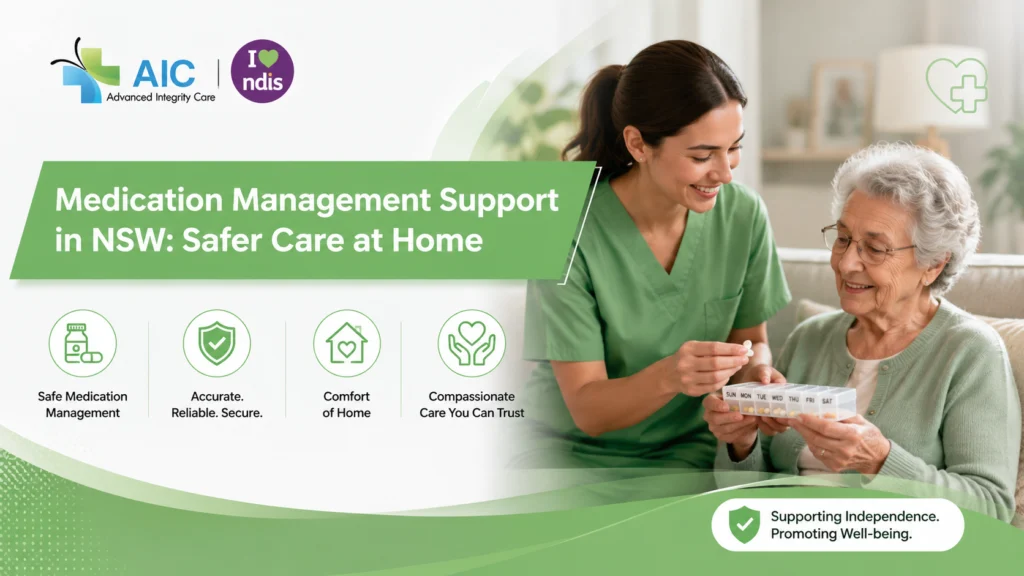
Medication management is a NSW government-funded program designed to provide professional medication management support to those requiring assistance in the proper use of their prescribed medicines while allowing them to continue living safely at home. Good support does not remove control from the person, it builds confidence, promotes independence and mitigates preventable risk.
It also provides reassuring peace of mind for families and carers.
Medication management support includes practical assistance that helps a person follow the medication plan prepared by their doctor, pharmacist or other authorised health professional.
Depending on the person’s needs, support may include:
A support worker does not own an independent decision on whether a conditions, prescribe medicine or switch a dose. Clinical decision making must always remain the responsibility of an appropriately qualified health professional.
Medication safety is presenting the right medication (prescribing, dispensing, administration and monitoring) according to the Australian Commission on Safety and Quality in Health Care. It also stresses that consumers must understand their medicines, needs and risk factors. Get details in Disability Services.
There are medicines that may improve health, reduce symptoms or help prevent complications, etc. However, missteps are possible when it comes to becoming overly complex in your habits.
The same thing can happen if they forget whether or not they took their morning dose and take it twice. What may happen is one person gets better then stops taking a medicine even though the prescriber told them to complete the course. Otherwise, an expired medicine can stay mixed in with current prescriptions.
These problems are more likely when a person:
Therefore, a clear and consistent medication routine can make daily care much safer.
The exact level of assistance should reflect the person’s care plan, preferences, abilities and clinical instructions. Some people only need a friendly reminder. Others may require closer assistance from trained or qualified staff.
| Type of support | Example at home | Main benefit |
| Medication prompting | Reminding a person that their evening tablets are due | Supports independence and routine |
| Physical assistance | Opening a child-resistant lid or pharmacy pack | Helps people with limited dexterity |
| Documentation | Recording the time a scheduled medicine was taken | Reduces confusion between carers |
| Storage support | Keeping medicines in a secure, suitable location | Prevents misuse and accidental access |
| Observation | Noticing dizziness, nausea, unusual sleepiness or a rash | Allows concerns to be escalated promptly |
| Pharmacy coordination | Helping organise prescriptions or a Home Medicines Review | Improves communication and continuity |
The aim is not simply to “give tablets”. Instead, safe medication support at home should form part of a coordinated approach involving the participant, family, pharmacist, GP, nurses and support team. Looking for a Best NDIS Provider in Cessnock?
While people at times tend to use these labels somewhat interchangeably, they cover very different roles.
An example of a mediation reminder would be informing the individual their medicine is due and encouraging adherence to their preexisting regimen. The citizen recognizes the the medicine and takes it themselves.
Medication support may include tangible help, such as handing the individual a dose packed by their pharmacy or assisting them with opening its packaging.
This usually involves a worker assuming an extended role with regard to the administration of medication — checking and administering the medicine in accordance with a prescribed plan. Thus the worker needs to have training in specific competencies or some clinical qualification depending on the medicine, method and individual circumstances.
An experienced provider will look at these needs before they begin support. They also need to ensure that every worker understands the scope of their role.
A strong routine reduces guesswork. Therefore, the care team should create a straightforward system that everyone can follow.
This can include prescription medicines, non-prescription products, vitamins and other supplements, and allergies with known reactions. It should also display the name of the medicine, strength, dose, timing and reason for using it.
Keep a list of your medications, and talk to your doctor or pharmacist when you are taking several products (Healthdirect).
Use the most up-to-date medication record or care plan where the use of authorised medicines is included. Especially after a change in the prescription, handwritten notes, verbal messages and old hospital discharge instructions cause confusion.
Medicines should remain in their original or pharmacy-prepared packaging unless a qualified professional advises otherwise. In addition, they should be stored according to label instructions and kept away from heat, moisture, children and anyone who may take them accidentally.
Clear records help prevent missed or repeated doses. They also allow incoming workers to understand what happened during the previous shift.
Support workers should know who to contact when they notice a possible reaction, documentation error, missing medicine or change in the person’s condition. In an emergency, they should follow the person’s emergency plan and contact emergency services. Get details on NDIS Provider in Maitland.
For those who take many medicines or find it hard to manage them, A Home Medicines Review—commonly referred to as an HMR—can help.
An HMR involves a credentialed pharmacist reviewing the home medicines of one patient at a time. The pharmacist may assess how well a patient takes their medicines, how well the medications are working and discuss any practical problems that might prevent safe use. Healthdirect says people who are eligible can get an HMR through their GP.
The pharmacist might notice that similar packaging leads to confusion, for example. Or they might find the patient has difficulty swallowing a certain tablet. This allows the pharmacist to be able to speak with the person’s doctor about safe choices then leave it up to that person or their support worker to potentially make an unsafe change.
There are also some NDIS Participants who might need assistance with basic health tasks because of their disability affecting their ability to do those safely. The NDIS describes a whole range of disability related health supports that may be funded through a participants plan when the person meets the relevant criteria within their plan. There will be doughnuts with school-related themes such as diabetes, seizure assistance and training for caregivers.
Funding, however, is based on the individual’s situation and plan that was approved. The NDIS is unlikely to provide funding for general medical treatment, basic pharmacy costs and services that are primarily the responsibility of the ordinary health system.
For this reason, participants are encouraged to review their existing plan or speak with their support coordinator, plan manager or NDIS contact prior to arranging services.
Good medication care must respect the individual.
Continue to be involved in every decision they can. Everybody deserves to get information in a way that they understand, plain English, visual instructions, an interpreter or extra time to ask questions if needed.
Workers should also honour privacy, cultural preferences and personal routines. Type of Management Some individuals may prefer to take the morning bedeutung am von ein before breakfast according one clinical directions. Another might require reminders related to a mundane life event.
Small details matter. In fact, when a routine is organic for the person instead of designed imposed system it works even better.
Related Services:
» SIL House Accommodation in NSW
Families often notice subtle changes before a serious incident occurs. Warning signs can include:
Early support may prevent these concerns from becoming larger health and safety problems.
Related Articles:
» When Do You Need In-Home Nursing Services?
» Medication Management Under the NDIS
» Safe Medication Management for Seniors and People with Disability
» Medication Management Support in NSW: Safer Care at Home
» Benefits of NDIS Wound Care & Medication Management
When comparing providers, ask how they assess medication needs, train workers and respond to incidents.
A trustworthy provider should have:
Above all, the provider should listen to the person receiving support. Safe care depends on clinical accuracy, but it also depends on trust and respectful communication.
Needing aid with medicine is not a loss of control of ordinary life.
With the proper medication support at home, people can stay involved in their own health decisions and get help where they need it. Families also get peace of mind that medication regimes are being followed, recorded and checked.
A quiet reminder, a precise record or a call to the pharmacist may be a tiny job. But these efforts may reduce confusion and promote safer care at home.
Advanced Integrity Care acknowledges the Awabakal and Worimi Peoples as the Traditional Custodians of the land on which we work. We pay our respects to Elders past and present and extend that respect to all Aboriginal and Torres Strait Islander peoples.
admin@advancedintegritycare.com.au
Call: (02) 49511530
2/5 Withers St, West Wallsend NSW 2286, Australia
