
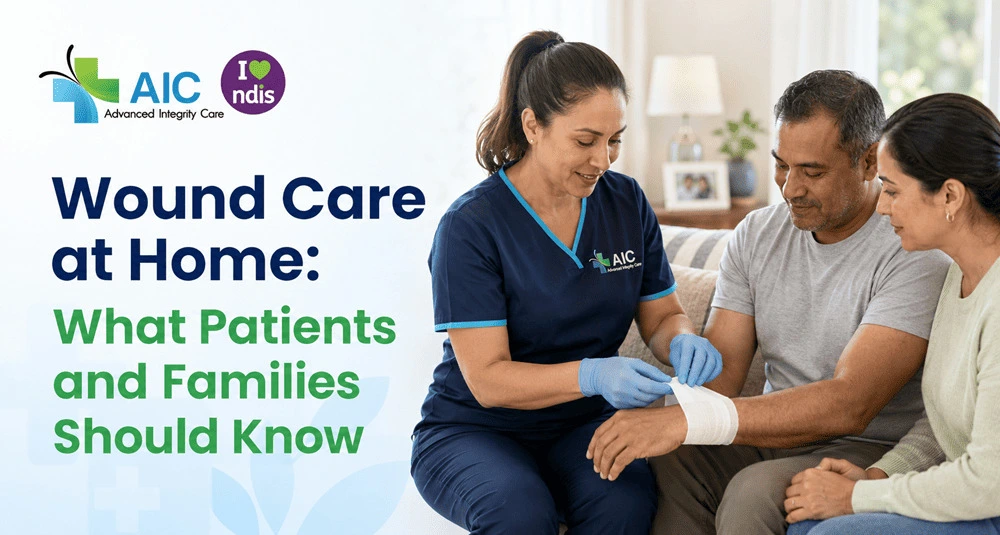
At first, recovering from a wound can seem very simple. But healing never really depends solely on a dressing. Other factors — such as the cause of the wound, a patient’s health in general, infection risks, their nutrition status and daily living activities — can influence recovery too.
Professional wound care at home can reduce stress and make treatment easier for older Australians, people living with a disability or patients returning home after surgery. It enables families to participate in care without having full clinical responsibility.
The home-based support component at Advanced Integrity Care – NSW places emphasis on comfort, safety and dignity as well as regular monitoring of the wound. Most of all, patients get treated in places with which they are more familiar and have a connection to the doctor, specialist or larger healthcare team.
Wound care at home means assessing, cleaning, dressing and monitoring a wound in the patient’s residence. Depending on the wound and the person’s needs, care may involve a qualified nurse, a GP, a wound specialist, allied health professionals and family members.
Home wound care may support people with:
The chronic wound is, by definition, a wound that has not healed in four weeks. For diabetic wounds, circulation issues, infection or even pressure-related injury can slow healing and require assessment. Get details on Wound Care Service in NSW.
Two wounds may look similar but require very different treatment. For example, a pressure injury needs pressure relief, while a venous leg ulcer may need circulation assessment and professionally prescribed compression therapy.
Therefore, families should avoid choosing dressings based only on appearance, online advice or previous experience. A nurse considers the wound’s:
NSW wound-care guidance recommends regular assessment and documentation, including changes in wound size, depth, discharge, odour and surrounding tissue.
| Wound type | Common concern | Typical home-care priority |
| Surgical wound | Infection or wound reopening | Protect the wound and follow discharge instructions |
| Pressure injury | Ongoing pressure and tissue damage | Repositioning, pressure relief and skin checks |
| Diabetic foot ulcer | Reduced feeling and slow healing | Blood glucose management and professional foot care |
| Skin tear | Fragile skin and further trauma | Gentle handling and non-adherent dressings |
| Leg ulcer | Swelling or poor circulation | Clinical assessment and an individual treatment plan |
| Minor cut or graze | Dirt, bleeding or infection | Clean, cover and monitor |
This table provides general guidance only. A qualified healthcare professional should decide the correct treatment for any complex, deep or slow-healing wound. Looking for a Medication Management Service in NSW?
Before changing a dressing, the patient or carer should follow the written wound management plan. Dressing frequency varies greatly. Some dressings need daily replacement, while others can remain in place for several days.
A basic dressing-change routine may include:
Saline or clean water can be suitable for certain wounds. But antiseptics, creams, powders and home-made solutions must never be spread unless advised to do so by the doctor. Saline, sterile water, safe lukewarm tap water and some appropriate wound cleanses are options identified in NSW clinical guidance according to the patient assessment of the wound and associated plans for management.
In addition, without training, family members should not be allowed to cut tissue that has died off, remove stitches, drain a wound or apply compression bandages.
Some discomfort can occur during healing. Nevertheless, pain, redness and swelling should generally improve rather than become worse.
Contact a GP, nurse or wound-care professional if the patient develops:
Australian guidance includes worsening pain, heat, swelling, redness or pus and fever as warning signs of infection.
For severe bleeding, loss of consciousness, difficulty breathing or other medical emergencies call Triple Zero (000). Care should be sought immediately if a foreign body is embedded in the wound and this should not be removed at home. Get details on Nursing Services in NSW.
The guide to wound healing is actually the whole person. Consequently, wound-care plans may involve more than just cleaning and dressing the affected area.
For repairing the lost component of tissues, you want rightly large measure of energy as healthy proteins, vitamins and minerals and furthermore fluid. In during the wait for healing, lack of urge for food, swallowing issues or unintended weight loss can worsen this. Implication for case-mix indices This suggests that a dietitian review may be indicated among those patients with chronic or complex wounds.
This can make In-Home nursing care in NSW is less travelling (especially for those with disability, pain, fatigue or mobility limits) Finally, nurses are trained to look at the home for health hazards that could negatively impact recovery, such as an improper mattress or any dangers or barriers that increase fall-risk or impede storing supplies.
There is actually professional handling advice for families though. For example, pulling someone across linen might cut superficial skin.
High blood glucose or periods of high and low sugar impair healing and increase infection risk. People with diabetes must follow their diabetes plan, examine their feet daily and report early if blisters, cracking or colour change in the skin occur or broken skin.
The oxygen taken to healing tissue can be diminished by smoking. On the other hand, alcohol is able to interfere with vitamins, medicines and the body’s ability to recover. Management of these risks may help with compliance with the treatment regimen. Looking for a Respite Care Services in NSW?
Families often notice subtle changes before anyone else. Even so, they should not be expected to replace trained clinicians.
A family member can help by:
It makes perfect sense too for a carer to speak up when something proves too arduous. Complex wound management, infection control and clinical assessment should rightly sit with those appropriately qualified.
Related Services:
In-Home nursing care could involve considerably less wasted travel even if you are located in nsw for Patients with disablement, pain and fatigue or limits of movement. Most importantly, nurses have all the tools to assess the home for any health hazards that could trigger a delay in recovery from an improper mattress to dangers or barriers to storing necessary supplies.
Professional home care can also provide:
In conclusion, safe home wound management is a combination of clinical expertise and practical, person-centred care. Patients should receive understandable instructions for how to proceed with their care, the criteria by which warning signs will emerge and an easily defined contact person.
Related Articles:
» How In-Home Wound Care Can Improve Comfort and Recovery?
» NDIS Wound Care Services in NSW
» Chronic Wounds & the NDIS: Can You Get Funding for Care?
» How Wound Care Services Improve Recovery and Comfort?
» Benefits of NDIS Wound Care & Medication Management in NSW
Some patients have specific clinical needs, some others have certain time schedules and applications. Thus, besides universal calibration this type of support for the wound should be proceeding.
Specialist care in home services for Advanced – NSW and all of the integrity that were trained to be aimed entirely at you. Depending on assessed needs or clinical orders, you can help with: wound observation; dressing assistance; skincare (with some limitations), pressure injury prevention & management monitoring of skin integrity and other healthcare providers
Training parents at home, patients and families with good support will be confident the recovery is under control and thus to prevent avoidable complications.
Advanced Integrity Care acknowledges the Awabakal and Worimi Peoples as the Traditional Custodians of the land on which we work. We pay our respects to Elders past and present and extend that respect to all Aboriginal and Torres Strait Islander peoples.
admin@advancedintegritycare.com.au
Call: (02) 49511530
2/5 Withers St, West Wallsend NSW 2286, Australia
