
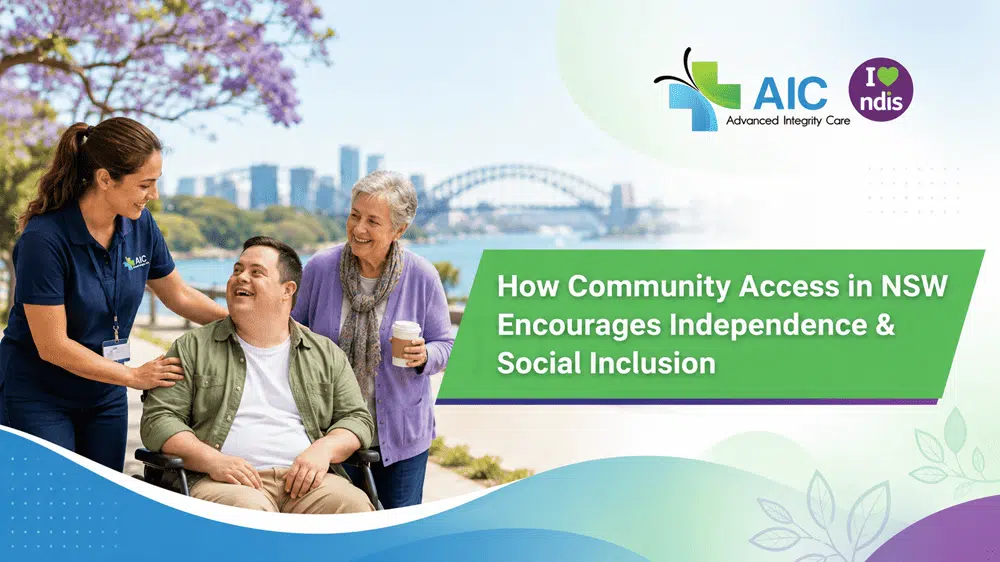
Community presence is much more than just getting out of the house. For a disabled person, it may offer opportunities to be involved in choice making, develop life skills, meet people and participate in everyday living. So appropriate community access in NSW will support the development of independence and confidence.
At Advanced Integrity Care – NSW we realize that every person has different goals. This could be someone who wants to have public transport in their training, or somebody else who would like to go and join a sports club, or go to an appointment at doctor’s surgery, or visit a local library — literacy. That is why good community participation support always follows the participants choices, interests and rhythms.
What Is Community Access Support?
Community access support allows people with disabilities to engage in activities outside the home. Depending on what the participant needs to do, support can be planning an outing, preparing for safe travel, talking to different people or paying money while shopping.
On the other hand, having a purpose is more than just performing an act. A planned outing trains a participant to be; these skills help during daily life as well. Ordering a meal might build communication, while catching a bus could boost confidence with routes, timetables and travel cards.
Community access activities may include:
- Visiting shopping centres, cafés or libraries
- Attending sporting events or exercise sessions
- Joining art, music or hobby groups
- Going to medical or allied health appointments
- Participating in cultural or religious events
- Learning to use public transport
- Volunteering within the local community
- Attending educational or employment-related programs
As a result, disability community access services can support practical development while also creating enjoyable experiences. Get details on Community Access Service in NSW.
How Community Access Builds Independence
Independence at the same time doesn’t mean I do everything totally alone. Instead it generally implies having more choice, control and say over our circumstances. This means that community access workers should assist participants to do as much as they can, rather than just taking over every task themselves.
For example, a support worker may assist participants with shopping lists prior to them going to the supermarket. The participant is then able to find products, check prices and complete the checkout process. There is still support on hand but the participant takes more of a leading role during the experience.
Over time, these small steps can build valuable daily living skills, including:
- Planning and organising activities
- Handling money and making purchases
- Reading signs and following directions
- Communicating needs and preferences
- Managing time and appointments
- Solving minor problems independently
- Making informed personal choices
Additionally, regular practice can reduce uncertainty. A place that once felt unfamiliar may gradually become comfortable and manageable.
Community Access Support: Doing For Versus Doing With
| Support approach | “Doing for” the participant | “Doing with” the participant |
| Choosing an activity | Worker selects the outing | Participant chooses from suitable options |
| Travel planning | Worker arranges everything | Participant helps check routes and times |
| Shopping | Worker collects and pays for items | Participant finds products and completes payment |
| Communication | Worker speaks on the person’s behalf | Participant receives support to express their needs |
| Problem-solving | Worker immediately fixes every issue | Participant considers solutions with guidance |
| Long-term outcome | May create reliance on support | Encourages skills, confidence and independence |
The “doing with” approach usually offers stronger opportunities for learning. Nevertheless, the level of assistance should suit the person’s abilities, safety needs and preferences. Looking for a Independent Living Service in NSW?
Supporting Social Inclusion Across NSW
Social inclusion for people with disability means having genuine opportunities to participate, belong and contribute. It does not simply involve being present in a public location. Instead, inclusion grows when people form relationships, share interests and feel welcomed by others.
For example, attending the same local art class each week can create familiarity. The participant may begin recognising other members, joining conversations and sharing their own work. Consequently, what started as an organised activity can grow into a real social connection.
Community engagement may help in minimizing social exclusion and loneliness. This is important because those who are stuck at home for long periods may have limited opportunities to meet people or pursue new interests. Social and community participation in NSW, therefore, can diversify a person’s daily life, bring purpose and pleasure.
Activities Should Match the Participant’s Goals
Ideally, a good community access plan never takes the cookie son approach. Some individuals like to go out when there is a lot of activity; others are great even in their peaceful time with fewer people around. For instance one participant might want more friends, whereas another perceives they have a greater independence with travelling alone.
Before planning an activity, support providers should consider:
- The participant’s personal interests
- Communication preferences
- Sensory needs
- Mobility and accessibility requirements
- Cultural background
- Health and safety considerations
- Short-term and long-term goals
- The amount of support requested
In addition, participants should have the freedom to change their minds. An activity may look suitable on paper but feel uncomfortable in practice. Good support remains flexible and listens without placing pressure on the person. Get details on Nursing Services in NSW.
Learning Practical Skills Through Real Experiences
Community-based learning usually seems more relevant to the real world. Rather than just talking about road safety at home, a participant will be able to practice it in their neighbourhood. Similarly, you can teach them budgeting when they help you with grocery shopping rather than using imaginary money.
These will likely involve the odd mistake, and that’s ok. For example, a missed bus or check the price of something before buying. But with a centre worker remaining calm, it becomes an educational exercise. That way, when the participant returns for the next time, they may feel more prepared.
Importantly, workers should balance independence with duty of care. They must identify genuine risks while avoiding unnecessary restrictions. This balance allows participants to try new things safely and with dignity.
How Community Participation Supports Confidence
Confidence often develops through repeated success. At first, a participant may need considerable reassurance when entering a new venue. However, after several visits, they may start greeting staff, finding their own seat or placing an order with less assistance.
Progress may appear small from the outside. Yet, for the participant, asking a question independently or travelling one stop further can represent a major achievement. Therefore, support teams should recognise personal progress instead of comparing one person with another.
Furthermore, positive community experiences can encourage participants to explore new goals. Someone who becomes comfortable at a local gym may later join a group class. Likewise, a person who learns to visit the library may eventually enrol in a course or community workshop. Looking for a Medication Management Services in NSW?
The Role of a Community Access Support Worker
A community access support worker in NSW provides assistance while respecting the participant’s rights and choices. Their role may involve transport, personal care, communication support, encouragement and help with planning.
However, a skilled worker also knows when to step back. They observe what the participant can do and provide assistance only where it adds value. In addition, they maintain privacy, communicate respectfully and encourage the participant to speak for themselves whenever possible.
Consistency can also help. When a worker understands the participant’s routine and communication style, outings may feel safer and less stressful. Still, the participant should remain at the centre of every decision.
Related Services:
» Disability Services in Chisholm
» Disability Services in Newcastle
» SIL House Vacancies in Newcastle
Choosing Community Access Support in NSW
When selecting a provider, participants and families should look beyond the list of available outings. The quality of the support approach matters just as much as the activity itself.
Consider asking whether the provider:
- Creates activities around individual goals
- Offers flexible and culturally respectful support
- Involves participants in planning
- Understands accessibility and personal safety
- Encourages choice rather than dependence
- Matches participants with suitable support workers
- Reviews progress and changes plans when required
At Advanced Integrity Care – NSW, our approach focuses on respectful, person-centred assistance. We aim to help participants explore their community, build practical ability and take part in activities that hold personal meaning.
Related Articles:
» How Community Access Services Support Independence Every Day?
» Community Access Support: What’s Included and How It Helps
» Why Community Access Matters for Health, Confidence & Social Connection?
» How Community Participation Support in NSW Boosts Wellbeing?
» Respite Care: Supporting Families When They Need It Most
» Finding Peace of Mind: Choosing the Right Respite Care Service
» Healthy Meal Planning for SIL Residents on a Budget
» Respite Care in Newcastle and How Does It Work?
» Understanding Council Support & Funding for Respite Care in Newcastle
» Nursing Services for NDIS Participants in Newcastle
Creating Stronger Connections Through Community Access
Participating in a meaningful way can alter the image of who an individual is in their community. By taking them out more often, they may gain confidence, ability and become less isolated. In addition, the wider community also benefits from everyone being able to participate, share and communicate.
Community access services in NSW should not just plug gaps Rather, they inspire development, option and authentic relationship. Whether that involves shopping unaccompanied, joining a group or learning to find something new while travelling between places, all of these positive experiences anchor you to a more active and self-directed life.

