
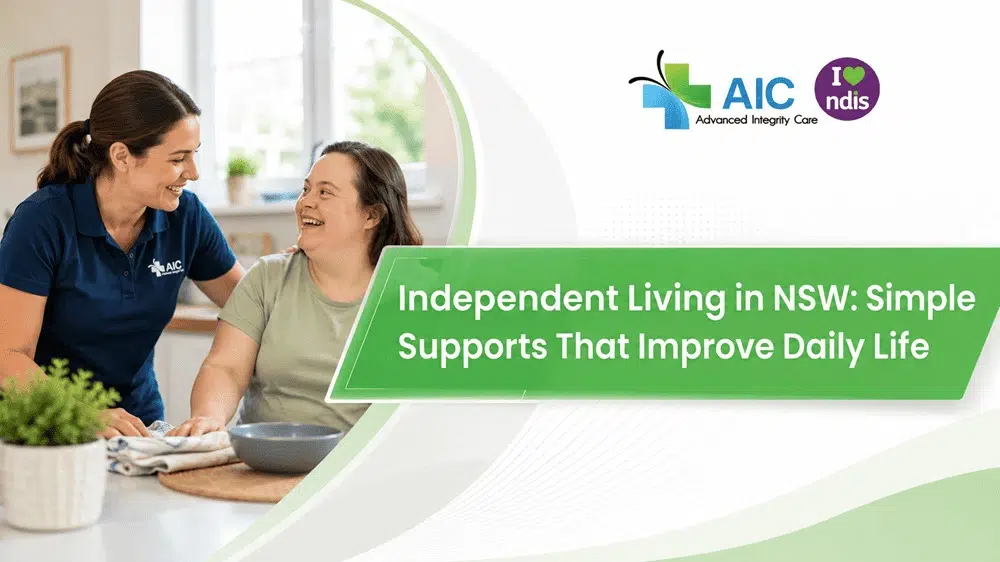
Living independently does not necessarily mean doing it all yourself. This is rather having control over your daily life and making personal choices etc. and if you need assistance help comes at the time when you want it. A little bit of practical help can create a safer, calmer, happier home life for many people with disabilities across New South Wales.
At Advanced Integrity Care NSW, we know that independence is not one-size-fits-all. Your support worker might be needed to help one participant prepare dinner, while another may want a support staff member to accompany them or assist with their appointments, run the household, or travel into the community. So good independent living support in NSW needs to be responsive, individualised rather than based on a process-based blanket approach.
What Does Independent Living Really Mean?
Independent living is about choice, dignity and participation. It can include deciding:
- Where and with whom you live
- What time you start your day
- How you manage meals and household tasks
- Which community activities you attend
- Who provides your disability support
- What personal goals you want to work towards
Most importantly, independence is not lost to those requiring regular help. And in fact, appropriate support leads to greater independence because it lowers barriers that make day-to-day life particularly challenging.
There are various home and living support options through the NDIS. Supported Independent Living, or SIL as it is commonly known, provides typically high amounts of in-home support for people with more complex needs who need assistance or supervision throughout the day and at night. Other people who require less support may also use other supports, such as personal care, household assistance or specialist disability accommodation. Get details on Independent Living Service in NSW.
Small Daily Supports Can Create Major Change
Not every person requires care around the clock. Otherwise, the little and simple support sometimes benefits most practically.
For example a support worker may spend an hour assisting a participant to plan meals, make a shopping list and prepare ingredients. As time goes on, the participant might start to cook easy meals with less support. Likewise, assistance with phone reminders can be used for remembering appointments, household chores or routines to take medications.
These activities may appear minor. However, they can increase confidence, improve safety and reduce dependence on family members.
Examples of Small but Valuable Supports
| Small support | Immediate benefit | Possible long-term outcome |
| Creating a weekly meal plan | Reduces daily stress | Better cooking and budgeting skills |
| Organising a morning routine | Makes the day more predictable | Improved time management |
| Assistance with grocery shopping | Helps the person buy suitable items | Greater confidence in the community |
| Setting reminders | Reduces missed tasks or appointments | Better self-management |
| Practising public transport routes | Improves travel safety | More independent community access |
| Breaking cleaning into simple steps | Makes household work manageable | Improved home maintenance skills |
| Support with online forms | Reduces confusion | Stronger digital confidence |
Help with Everyday Household Tasks
A clean and well organised home can be beneficial for physical health, mental health and personal safety. However, many activities that were once easy like vacuuming, laundry and washing dishes and changing bed sheets can be challenging due to low mobility, poor energy levels or pain or cognitive functions.
Daily living assistance may involve doing tasks with the participant, instead of performing each task for them. The participant may be folding clothing whilst the support worker is using the washing machine to wash their clothes. Or the worker might clean difficult to reach places while a participant does lighter tasks.
This shared approach builds practical skills and protects the person’s independence. Moreover, it avoids creating unnecessary dependence. Looking for a Disability Services in NSW?
Meal Preparation and Nutrition Support
Cooking involves several separate abilities, including planning, budgeting, shopping, food safety and following instructions. Therefore, a participant may need support with only one part of the process.
A disability support worker can help someone:
- Plan simple and balanced meals
- Read food labels
- Prepare a shopping list
- Use kitchen appliances safely
- Cook according to dietary instructions
- Store leftovers correctly
- Build confidence with familiar recipes
When the supports meet the participant’s approved needs, supported living assistance may also involve skill-building in cooking, cleaning and regimen development.
A good worker does not take the kitchen over but encourages people to join. Simple however useful strides like washing products of the soil, estimating fixings, can be extremely fulfilling.
Personal Care with Respect and Privacy
For instance, some may require help with personal routines or dressing, such as showering, grooming or toileting. Because these tasks are private, care should always likewise be taken to insure the participant’s; dignity, comfort and preferences remain protected.
The participant must have a voice in the delivery of support. They number one: only want a worker of a sure gender, desires assist at a positive time or behaviour options to fit their cultural routines.
Furthermore, workers should communicate clearly before providing physical assistance. Respectful personal care support in NSW is not only about completing a task. It is also about helping the person feel safe, heard and in control. Get details on Nursing Services in NSW.
Building Better Routines at Home
Routines can reduce anxiety and make daily responsibilities easier to manage. However, an effective routine should remain flexible enough to reflect the person’s lifestyle.
A support worker may help create a visual schedule, phone checklist or weekly planner. The routine might cover:
- Waking and bedtime
- Meals and hydration
- Personal care
- Household jobs
- Appointments
- Exercise
- Social activities
- Quiet or recovery time
Initially, the worker may provide regular prompts. Then, as confidence improves, they can gradually reduce those prompts. Consequently, the participant develops skills without feeling rushed or abandoned.
Community Access Is Part of Independent Living
Independent Living is also more than just being safe inside your home. As well as being places that provide food, housing and healthcare, people need opportunities to shop, study or work and socialise with others in their local community.
Support for participation in the community may also include helping participants go to a library, get to a class, catch up with friends or join a recreation group or practise using public transport. Apart from reducing feelings of isolation, these activities can develop communication, decision-making and travel skills.
You could do something like have a worker trail a participant on a bus trip at first. They might later only just do route planning. At the end of this, too, he would be alone for a portion or all of the journey. Looking for a Respite Care Services in NSW?
Technology and Simple Home Adjustments
Independent living is about more than just being safe in the home. They also need places that provide opportunities to shop, study, work socialise and participate in their local community
Support to participate with the community may involve the participants going to a library, attending a class, meeting friends, meeting input groups or practicing public transport. In addition to helping alleviate isolation, the training will also help build communication skills, travel and decision-making skills.
Everyday life can also be facilitated by smaller pieces of technology. Such aids may include visual timers, reminder apps, easy-to-grip utensils or even voice-controlled tools depending on the needs of that individual and what supports are approved.
Related Services:
» Medication Management Service in NSW
» SIL House Vacancies in Newcastle
» SIL House Vacancies in Hunter
» SIL House Vacancies In Cessnock
Choosing the Right Level of Support
Independent living support should match a person’s actual needs. Too little assistance may create unnecessary risks. On the other hand, too much assistance can limit choice and prevent someone from practising useful skills.
| Support approach | What it looks like | Best suited to |
| Prompting | Verbal or visual reminders | People who can complete tasks after a prompt |
| Skill-building | Practising tasks step by step | Participants working towards greater independence |
| Partial assistance | Help with difficult parts of a task | People who can manage some steps independently |
| Direct assistance | Worker completes most or all of a task | Participants with significant physical or cognitive support needs |
| Supervision | Worker remains nearby for safety | People who can perform a task but face identifiable risks |
Regular reviews also matter. A participant’s confidence, health, home environment or goals may change. Therefore, providers should adjust their approach instead of assuming that the same support will always remain suitable.
Related Articles:
» Independent Living Support in NSW: How It Builds Daily Confidence?
» How Independent Living Support Can Build Daily Confidence?
» Benefits of Independent Living Services for Adults with Disabilities
» Enhancing Independence and Well-Being with Disability Services
» How Disability Services Empower Individuals & Enhance Independence?
How Advanced Integrity Care – NSW Can Help
Advanced Integrity Care – NSW provides practical, person-centred support that respects the choices of each participant. We can support you with personal care, cleaning domestic tasks and use your skills in the community to develop new ones as needed.
More importantly, we seek to collaborate with our participants rather than simply do for them. Respectful, modest help can build assurance that life is much more manageable.
Independent living is not often an all-or-nothing situation. It grows in the mundane, not through life changing epics: cooking breakfast, taking a bus to class, doing laundry or deciding how to spend the afternoon. When supported well, these mini triumphs can facilitate a life that is more confident and self-directed.

