
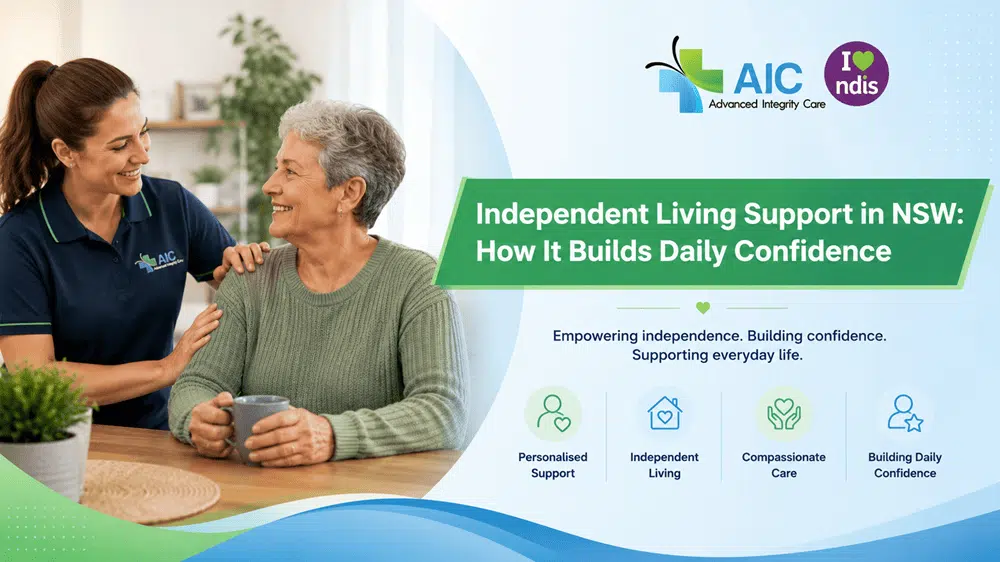
Independence does not imply doing everything by oneself. Rather, it means having much better help in making my decisions, the development of useful skills and a greater autonomy over everyday life.
For people with disability, whether in the home or community, independent living support in NSW will transform average daily activities into practical confidence development. Making breakfast, getting the bus or train or arranging a weekly shopping list may feel like a win. But with every accomplishment comes a little more faith in one self.
Independence is subjective for every individual at Advanced Integrity Care – NSW. Support should be in line with what the participants want, are able to do or even prefer and the people surrounding him and functioning not based on fixed patterns.
What Is Independent Living Support?
Advice on independent living allows an individual to conduct their everyday life while learning and practicing essential skills. Support can be provided at home, in supported accommodation or in the community, depending on individual requirements.
Support can include:
- Personal care and morning routines
- Meal planning and cooking
- Cleaning and household organisation
- Grocery shopping
- Budgeting and money-handling skills
- Medication prompts
- Public transport training
- Appointment planning
- Social and community participation
- Building communication and decision-making skills
A support worker must not simply assume complete control of every task. Instead, they can prompt with a tip, show the repeating steps and encourage sleight of hand. As the participant becomes more comfortable, there may be less of a need for assistance. Get details on Independent Living Service in NSW.
How Daily Tasks Build Real Confidence
Confidence occurs through continual experience rather than singular success. A participant might start making a sandwich with prompts. Then they can write an easy recipe, go to the shop and prepare it with just a few things.
As a result, there is so much more the person learns other than about cooking. They also practice planning, communication, time management and problem solving.
The same process applies to many household and community activities.
| Daily activity | Skill being developed | Possible confidence outcome |
| Preparing meals | Planning, food safety and coordination | Greater confidence in managing personal nutrition |
| Doing laundry | Following steps and organising time | Increased responsibility for personal belongings |
| Grocery shopping | Budgeting, communication and decision-making | More confidence in community settings |
| Using public transport | Route planning and personal safety | Greater freedom to attend activities |
| Managing appointments | Time awareness and communication | Improved control over health and personal commitments |
| Cleaning a bedroom | Organisation and task completion | Pride in maintaining a personal space |
Although progress may appear gradual, these everyday achievements can create meaningful long-term change. Looking for a Community Access Service in NSW?
Support That Encourages Choice
Choice plays a central role in disability independent living support. Without genuine choice, a person may follow instructions but fail to build confidence in their own judgement.
A participant might choose what to cook, which household task to complete first or what clothes to wear. Likewise, they may decide which community activity interests them or how they would like their room organised.
Support workers can explain available options and discuss possible consequences. However, wherever it is safe to do so, the final decision should remain with the participant.
As a result, the person learns that their opinions matter. They also become more comfortable expressing preferences, setting boundaries and speaking up when something doesn’t feel right.
Building Skills Without Taking Over
Good support balances assistance with opportunity. When workers complete everything quickly on behalf of a participant, the household may run smoothly, but the person can miss valuable chances to learn.
A more empowering approach may involve:
- Explaining the task clearly
- Breaking it into manageable steps
- Demonstrating unfamiliar actions
- Allowing enough time to practise
- Offering prompts only when needed
- Recognising effort and improvement
For instance, rather than preparing an entire meal, a worker might help the participant select a recipe and safely complete each stage. Next time, the participant may need fewer reminders.
Therefore, support remains available without creating unnecessary dependence. Get details on Respite Care Service in NSW.
Developing a Predictable Daily Routine
A well-defined routine can help reduce the stress of daily living. It could even support memory, emotional regulation and time management.
Something like take a shower, get dressed, make breakfast and glance at the calendar for what lies ahead. They could also assist you with an evening routine that may include straightening up your room, laying out clothing for the next day and reminders.
Visual schedules, reminders on phones, writing a checklist and even labelling the storage places are all methods that can make these routines easier to implement. Nonetheless, routines should also stay flexible simply because plans change sometimes.
Over time, familiar patterns can reduce uncertainty. Consequently, the participant may start tasks without waiting for another person to direct every step.
Confidence Beyond the Home
Independent living skills also have a bearing on how easily someone is able to engage with the wider community. Having built up some confidence at home, a person may be raring to go to the local café, to join a recreation group or an appointment.
A support worker may initially travel with the participant and explain each stage of the journey. Later, the worker could provide less direct assistance while remaining available if a problem occurs.
These experiences may help a person:
- Communicate with shop staff
- Ask for directions
- Handle money
- Follow transport timetables
- Recognise unsafe situations
- Make social connections
- Attend local events and activities
Also, being involved in the community on a regular basis can help lessen loneliness and foster a better sense of belonging. Looking for a Nursing Service in NSW?
Independent Living Support and NDIS Goals
They may be working on their NDIS goals in relation to independence, daily living skills, community access or moving into the home they want.
But the type of individualised care and support they deliver through Supported Independent Living (SIL) means something very different in NDIS-speak. SIL is most often provided to people with higher needs who require continuous assistance or supervision overnight and/or during the day. It is tied to assistance provided in-home, versus what lodging, food, lease or utilities cost.
Other participants may receive different home and living supports, personal care assistance or Individualised Living Options. Therefore, the most suitable arrangement depends on the person’s disability-related needs, living situation and approved NDIS plan.
A participant, nominee or family member should discuss appropriate supports with their NDIS contact, support coordinator or allied health professional.
Signs That Support Is Building Confidence
Progress doesn’t always happen in a straight line. Some days will feel easier than others. Nevertheless, several changes may show that independent living support is working well.
The participant may:
- Begin familiar tasks without being prompted
- Ask for help more clearly
- Try a new activity despite feeling uncertain
- Make everyday decisions more quickly
- Recover more calmly after a small mistake
- Complete more steps within a task
- Take pride in their home and belongings
- Express preferences and personal boundaries
- Travel to familiar places with less assistance
- Set new goals after achieving earlier ones
Related Services:
» SIL House Vacancies In Newcastle
» SIL House Vacancies in Cessnock
Person-Centred Support Makes the Difference
Not everybody develops independence in precisely the same manner. For instance one participant may want to learn public transport skills; another might decide that the important thing is cooking, personal care or maintaining a tenancy.
For that reason, person-centred disability support in NSW should begin with listening. Workers need to understand the person’s communication style, cultural background, strengths, interests and preferred pace of learning.
Additionally, goals should remain realistic and measurable. “Become independent” is broad. On the other hand, “prepare breakfast with no more than one verbal prompt” gives everyone a clear target.
Regular reviews can then identify what is working and where the support approach needs adjustment.
Related Articles:
» Signs You May Benefit from Independent Living Support
» How Independent Living Support Can Build Daily Confidence?
» A Simple Guide to Independent Living Assistance in NSW
» What Is Supported Independent Living?
» What to Expect from Independent Living Services?
How Advanced Integrity Care – NSW Can Help
At Advanced Integrity Care – NSW, we support people to participate actively in their own daily lives. Our approach focuses on respect, safety, dignity and practical skill development.
Support covers daily living activities based on a participant’s needs and plan, it can include support with personal care & hygiene, household tasks, meal preparation & community access. In addition, we want participants to take their time in making decisions and practising skills.
Independence rarely appears overnight. It flourishes through this days-long opportunity to try, consistent affirmation and support that knows when to support—and when to hold back.

