
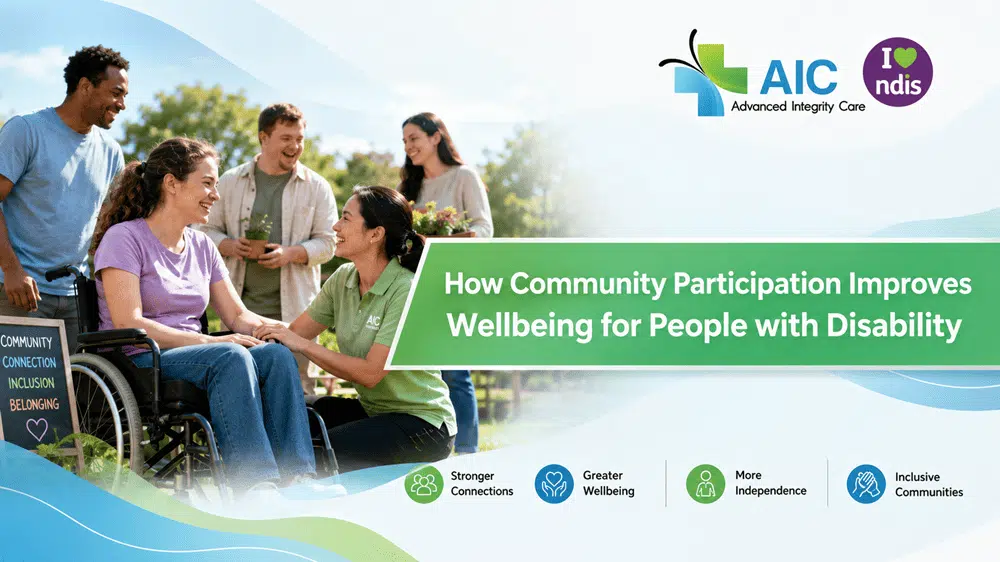
Interacting with the individuals, providing you with a feeling of belongingness Natural forms of belonging are chatting with a neighbour, joining a local art class, participating in community sport or helping run an event in your street—all contribute to real connection and sense of place. These experiences are also likely to foster confidence, independence and wellbeing amongst people with disabilities in those daily activities.
But meaningful engagement is infinitely more than just attending an event. People should still be able to choose their destination, activities and company. But they also need the appropriate support without losing control of what things you end up deciding on.
At Advanced Integrity Care – NSW, we recognise that each person has different interests, abilities and goals. Therefore, effective community participation support should always start with the individual rather than a fixed program.
What Does Community Participation Mean?
Community participation for people with disability means taking part in social, recreational, educational, cultural or civic activities within the wider community.
Depending on the person’s interests, this may include:
- Joining a local sporting or fitness group
- Attending markets, festivals or community celebrations
- Taking part in music, craft or cooking classes
- Visiting a library, museum, cinema or park
- Volunteering for a local organisation
- Meeting friends for lunch or coffee
- Learning to use public transport
- Joining a social club or peer-support group
- Participating in cultural or faith-based activities
- Building skills through study or work experience
Why Social Connection Matters
We are nurtured by social connection — both for our mental and physical health. And those with disability were hardest hit, as poorly equipped venues failed to make it work and transport was less accessible; they also faced communication and memory challenges—combined with poverty and stigma or fears of stigma from the community.
Why Inclusion Should Be In The Spotlight Data Dumped Down Under In 2021, around people aged 15-64 with disability, 19% were socially isolated compared with 9.5% without disability. Another 27% of the five or older people with disability said they did not leave home as frequently as they would have liked to.
As such, good disability support services in NSW can prove significant. For instance they might support a participant to plan an outing, change their communication style, keep safe or acclimatise to a new environment. Through practice, they will require less coaching as they develop their ability and confidence. Get details on Community Access Service in NSW.
How Community Participation Supports Wellbeing
1. It Reduces Loneliness and Isolation
People are a great antidote to loneliness – stay in touch with them. That means, for example, that they might go to the same weekly program where they see similar people and establish slow connections.
And once again friends are made with things in common not on forced meetings. This makes it simple to talk about something that is just happening naturally such as a gardening group, zwift or swim. More specifically, the stronger those connections get, the more likely it is that a person will feel significantly supported both in and out of the activity.
2. It Builds Confidence and Self-Esteem
Starting anything in a different form is one way to step outside of your comfort box. Every experience that is a good one builds confidence.
For example, a participant might begin by ordering their meal and ask the shopkeeper or introduce themselves to other group members. These might feel like small things but they are massive steps towards your own self-development.
Consequently, social and community participation can assist individuals in acknowledging their capabilities. Then that confidence could extend to many other facets such as education, work, relationships and autonomy.
3. It Develops Everyday Skills
Community activities provide practical opportunities to develop useful life skills. Rather than practising everything in an artificial setting, participants can learn through real situations.
For instance, a trip to the shops may involve creating a list, checking prices, handling money and speaking with staff. Similarly, travelling to a community centre can build planning, time-management and transport skills.
| Community activity | Skills that may develop | Possible wellbeing benefit |
| Grocery shopping | Budgeting, communication and decision-making | Greater independence |
| Group sport | Teamwork, coordination and resilience | Improved fitness and confidence |
| Art or music class | Creativity, concentration and self-expression | Emotional relaxation |
| Volunteering | Responsibility, communication and work habits | Stronger sense of purpose |
| Café outing | Social interaction, money handling and choice-making | Increased community confidence |
| Public transport practice | Route planning, safety awareness and time management | More freedom of movement |
Consequently, participation can support both immediate enjoyment and longer-term independence. Looking for a Disability Services in NSW?
4. It Encourages Physical Activity
Many community experiences involve movement. Someone can easily stay active by simply walking through the market, swimming, dancing, bowling or visiting a park.
Naturally, tasks should always be tailored to the ability of the individual taking part and their mobility, fat reduction goals, and any wellness specifications. However, physical activity does not have to be a competitive sport. Heck, just even gentle movement can help with mobility (even without flying), sleep, energy and overall health.
Furthermore, exercise can be easier to stick with when it is less clinical and more social or fun.
5. It Creates a Sense of Purpose
Having something of meaning to look forward to helps people generally feel better. This is where an activity in the community, once a week, can provide structure and plan your week.
Because it involves giving up your time, knowledge or skill at no cost; volunteering can be the most valuable form of social capital possible. Not just getting support, but actually becoming part of their community.
Likewise, just attending a regular class or helping to organize an event will create a strongly valued role. Belonging, being a member of an in-group can compensate for missing bits of self-esteem and identity.
6. It Supports Choice and Control
It is never simply making all of their choices for them in the name of support. Rather, it reminds the participant about their options so that they can make safe decisions.
A support worker might mention a number of local activities, explain transport arrangements and highlight any issues with access. The participant can decide what is right for them after that.
It is person-centred disability support in that it privileges the disabled person’s own preferred lifestyle, culture, communication style and rights to take reasonable risks. Because real inclusion cannot exist without choice.
7. It May Open Pathways to Education and Employment
Community involvement can also be skill building for future study or work. They may also help with communication, time management, teamwork, problem solving and confidence in new surroundings when in a group setting.
Participants can also find their interests through volunteering or work-experience opportunities. They could also get to know people to guide them, connecting references or jobs.
Although employment may not be every participant’s goal, having opportunities to explore interests still supports personal growth. Get details on Respite Care Service in NSW.
What Can Prevent Meaningful Participation?
A person may want to become more involved but face practical or emotional barriers.
| Common barrier | Possible support approach |
| Limited transport | Travel training or assistance from a support worker |
| Anxiety in unfamiliar places | Gradual introductions and pre-visit planning |
| Communication difficulties | Visual aids, communication devices or extra time |
| Inaccessible facilities | Researching suitable venues before the activity |
| Low confidence | Beginning with short, familiar outings |
| Sensory sensitivity | Choosing quieter sessions or less crowded locations |
| Previous negative experiences | Listening carefully and rebuilding trust gradually |
| Lack of information | Exploring local programs based on personal interests |
Notably, the solution should not be to exclude the person or lower their goals. Instead, providers should work collaboratively to remove barriers wherever possible.
What Does Quality Community Participation Support Look Like?
Quality support should feel respectful, flexible and purposeful. It should never resemble passive supervision or a one-size-fits-all excursion.
A suitable provider will:
- Listen to the participant’s interests and goals
- Respect cultural identity and personal preferences
- Offer real choices rather than fixed activities
- Check accessibility, transport and safety requirements
- Encourage skill development without applying pressure
- Support communication in the participant’s preferred way
- Review progress and adjust activities when needed
- Help the person build natural relationships in the community
In addition, Support should support what participants care about (outcome). For some, it would be to make new friends while for others it might be to travel on their own or get ready for work. This entire progress and positivity journey will manifest differently for everyone, and that’s just fine. Looking for a Disability Services in Chisholm?
Starting with Small, Achievable Steps
Community participation is not something you have to do starting with a huge gathering or taking up your full day outside of home. Smaller experiences in fact tend to provide a more solid outcome.
A person might start by visiting a familiar café during a quiet period. Next, they may order independently or speak briefly with staff. Later, they could invite a friend or try a busier venue.
Because confidence grows through positive experiences, gradual support can help the participant feel safe without becoming overly dependent. The aim is not to rush. Instead, it is to create steady progress at a pace that feels right.
Related Services:
» Disability Services in Newcastle
» Independent Living Service in NSW
» Medication Management Services in NSW
How Advanced Integrity Care – NSW Can Help
At Advanced Integrity Care – NSW, we assist people with disability to experience their community in the way that they want based on their unique goals, interests and support requirements.
This might involve supporting participants to attend an appointment, participate in social activities or work on daily living skills, and even develop hobbies or confidence in the community. Most importantly, we listen. We do not take for granted that every participant wants the same experience
Community access support in New South Wales helps participants develop connections within the community, learn new skills and gain confidence through everyday experiences. And families and carers may also be reassured that the person is receiving help in a respectful way, while preserving choice, dignity.
Related Articles:
» What to Expect from Community Access Services in Newcastle?
» NDIS Community Engagement Programs for People with Disabilities
» How Community Access Services Support Independence Every Day?
» Community Access Support: What’s Included and How It Helps?
» Why Community Access Matters for Health, Confidence & Social Connection?
» How Community Participation Support in NSW Boosts Wellbeing?
» How Personalised Disability Support in NSW Helps You Reach Your Goals?
» How to Choose the Right Disability Support Provider in NSW?
» Benefits of Respite Care for Families and People with Disabilities
» How to Choose the Right Disability Support Provider in NSW?
Building Communities Where Everyone Belongs
Everything that falls under the category of community participation brings something positive, but it is not entirely for your own benefit. Local clubs, businesses and organisations become more informed, welcoming and inclusive of people with disability when they actively participate in mainstream community life.
That means that disability could be part of the fibrous diversity of mainstream community rather than one more thing to extract. Humans meet other humans, grind for one another and become real.
In the end, wellbeing flourishes when humanity is acknowledged, valued and embraced. When offered with the right opportunities and support, people with disability can engage in things they are passionate about, cultivate skills that matter to them, and live a life able of meaningful connection for their lives.

